
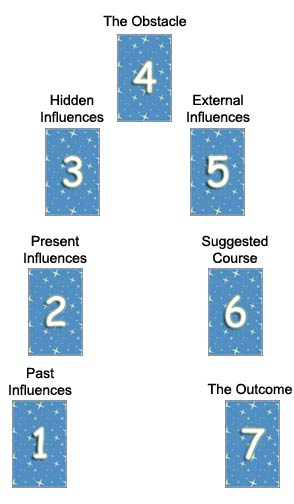
The seven-card Horse Shoe is a convenient, basic layout that can be used to answer different types of questions, especially concerning questions where insight would be helpful. Like several other layouts, it has tiles representing the past, present, and future.
The pinnacle of the Horse Shoe, looking like the top of the mountain, shows the obstacle or challenge that needs to be addressed and overcome. Tile #6 suggests a course of action to meet this challenge. The final tile shows the outcome or future, should this advice be followed.
Other clues are provided in Tiles #3 and #5, which indicate hidden or outside influences that come into play, affecting the journey to your goal.
Obstacle 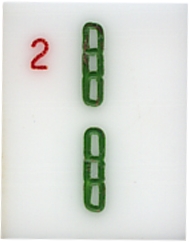 Bamboo 2 |
||
Hidden Influences 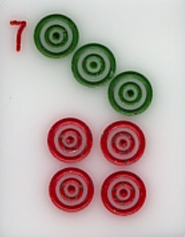 Circles 7 |
External Influences 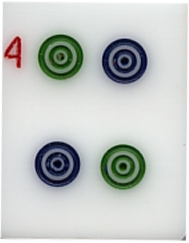 Circles 4 |
|
The Present 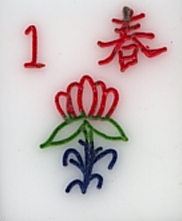 Plum Blossom |
Suggestion 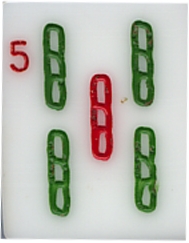 Bamboo 5 |
|
The Past 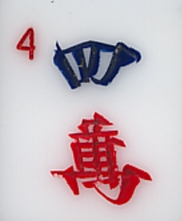 Wan 4 |
The Outcome 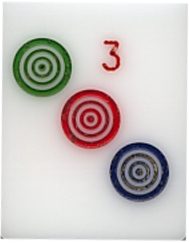 Circles 3 |
The Past Tile represents past events that are affecting the question.
Wan 4
The Lute suggests that it would be a great time to take a vacation. Relaxation and a temporary disconnection from the duties of everyday life would be especially beneficial at this time. If you can't get away too long, at least take a break and meditate. The clarity will surprise you.
Plum Blossom
The Plum represents spring, youth, innocence, inexperience, and childlike happiness. It may be a sign that you need a fresh perspective on something. Something in your life may need to be re-evaluated.
Circles 7
The Insect represents gain in the short term. It suggests temporary work, small projects, and perhaps freelance. There will be short term gains, but don't rely upon this for too long. This is a transitional time when you should be planning for the future.
Bamboo 2
The Duck symbolises enduring partnerships – long lasting relationships with the strength to overcome all obstacles. It suggests fidelity and trustworthiness, just as ducks are monogamous for life.
Circles 4
The Jade tile is about lasting values and convictions. It indicates strong commitments, longevity, and vibrant health. It sometimes foretells hard work resulting in impressive gains.
Bamboo 5
The Lotus flower represents fertility and more specifically birth. It may indicate an addition to the family or perhaps a new project to occupy your days. This is also a symbol of healing and constant regeneration, also self-sufficiency.
Circles 3
The Phoenix is a sign of great splendour and good feelings. Reborn out of the ashes, this sign represents rebirth, new discoveries, awakenings, healings, regeneration, and epiphany. A powerful recovery is suggested.