
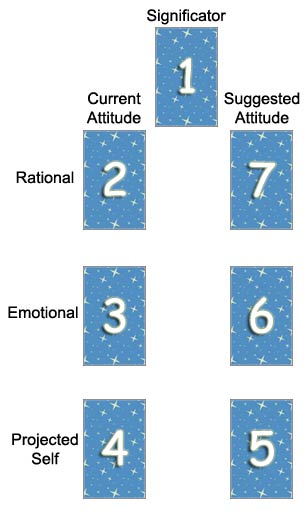
The Path #1 is laid out in a grid utilising two columns and three rows.
The first of the three rows shows rational or intellectual thoughts concerning the question. The second row is concerned with emotional attitudes, meaning feelings. The bottom row represents your posture or stance, meaning how you project yourself outwardly, to the world.
The left column shows how you currently think, feel, and act regarding your concern. The right column suggests advice on how to change your attitudes on these three levels to provide the most beneficial outcome. The trick is to compare and contrast the two columns, which gives hints as to what the runes mean and how to make changes, small or large.
| Current | The Significator Berkano |
Suggested | |
| Thought |  Hagalaz |
 Jera |
|
| Emotion |  Fehu |
 Mannaz |
|
| Posture |  Wyrd |
 Othala |

The Significator
The Rune of birth may symbolise a time of great personal insight and development. Naturally this is also a sign of abundance and fertility, so love may very well be in the air.

The sign of hail represents massive destruction and devastation. Times of chaos can be difficult to navigate, but there are times when disastrous disruption unfortunately become necessary. Do not allow yourself to get carried away in the storm.

This rune literally means "year" and stands for the harvest of a good year's labours. It represents a permanent change for the better. Jera denotes fruitful, recurring cycles, and strong fertility.

This is one of the mother stones – the rune of unbridled creative energies. Being associated with Frey, this Rune is a powerful omen of fertility. The presence of this rune in a reading only adds weight to its meaning.

This sign indicates a down time, perhaps depression. Now may not be the best time to make important decisions. If you are not thinking clearly, put your trust in those you have always trusted. This may not be the best time to make new friends.

The blank rune is used only in rune casts. Wyrd is not part of the runic alphabet. When this rune appears, it often symbolises a major change. If this rune is drawn in a single-rune cast, it suggests to ask this question again at a later time.

Othala represents a fortress of prosperity and security. Good character attracts good fortune. Those who have it are the ones who get it. That's simply the way things are. You are fortunate to be one of the lucky ones. At the same time, we all make our own luck.