
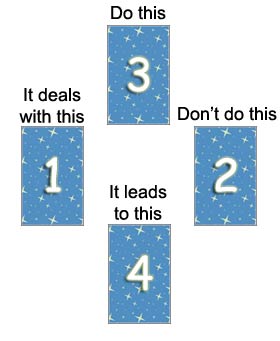
This easy-to-read four-card layout is one of the most useful of all the spreads. The first card is the significator, and the last shows the outcome, provided that the advice given is followed. The advice is broken down into two cards which can easily be compared and contrasted. Card #2 suggests what to avoid, while #3 shows the path to take.
This spread can also be used to ask about the meaning of a card from a previously executed spread that may have been unclear. In this usage, Card #2 shows what it did not mean, while #3 clarifies the meaning.
DO This The Hierophant |
||
It Deals with This 7 of Wands |
Do NOT Do This 2 of Wands |
|
It Leads to This 5 of Swords |

It Deals with This
A young man on a craggy eminence brandishing a staff; six other staves are raised towards him from below.
Upright Meaning:
Valour, discussion, wordy strife, negotiations, war of trade, barter, competition. It is further a card of success, for the combatant is on the top and his enemies may be unable to reach him.

A tall man looks from a battlemented roof over sea and shore; he holds a globe in his right hand, while a staff in his left rests on the battlement; another is fixed in a ring. The Rose and Cross and Lilly should be noticed on the left side.
Reversed Meaning:
Trouble, fear, physical suffering, disease, chagrin, sadness, mortification, trivial disappointments.

Seated on his throne, the Pope symbolises the male understanding of the spiritual workings of the world and traditional values. Two monks flank him on either side.
Reversed Meaning:
Society, concord, overkindness, weakness, doormat, misinterpretation, misunderstanding.

A disdainful man looks after two retreating and dejected figures. Their swords lie upon the ground. He carries two others on his left shoulder, and a third sword is in his right hand, point to earth. He is the master in possession of the field.
Upright Meaning:
Degradation, destruction, revocation, infamy, dishonour, loss, disdain, notoriety.